Online ordering system for takeaways: what it needs to do
A takeaway owner in Bolton showed us his Just Eat statement last year. Thirty-one per cent of the orders on it came from four postcodes within a mile of his shop, from numbers that appeared on the statement every single week. He was paying commission on customers who could see his sign from their front door.
That is the problem an online ordering system solves, and it is worth being precise about what one actually is, because the phrase gets used for three different things.
What an online ordering system for a takeaway actually is
It is a website, under your name, that shows your menu, takes the order, takes the money, and gets the ticket to your kitchen without anybody re-keying it. That is the whole job. It is not a listing on somebody else’s marketplace, and it is not a PDF menu with a phone number underneath.
The distinction matters because the three are sold interchangeably. A listing puts you on a page beside two competitors and an advert. A PDF menu makes the customer do the work of ringing up and reading out. Only the third one gives you the order, the customer’s details, and the right to contact them again.
What it has to do before it is worth having
Most takeaway checkouts are tolerated rather than enjoyed, which is why people drift back to the apps out of habit. If your own site is not better to use than the app, price alone will not move anybody. These are the things that decide it:
- It has to be finishable on a phone in under a minute. Menu, options, basket, pay. Every extra screen loses people, and the people it loses are disproportionately the ones ordering at eight on a Friday with one hand.
- The menu has to read properly. Sizes, add-ons, swaps, meal deals, spice levels, the half-and-half pizza. If your menu is complicated, the system has to be able to express it, or your staff spend the evening fixing orders over the phone.
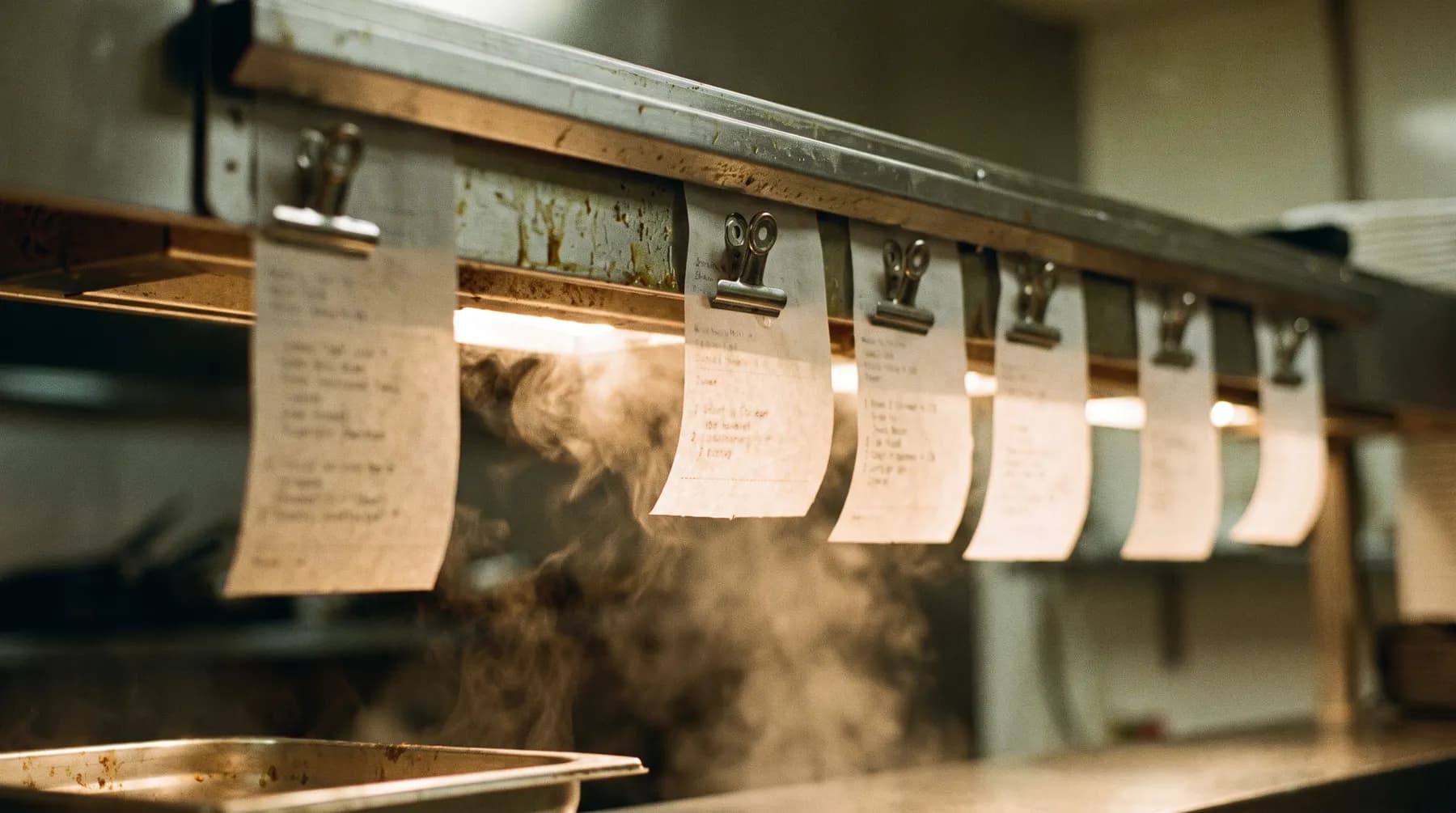
- The order has to reach the kitchen on its own. A receipt printer on the network, an order screen, or both, with an audible alert and a queue on screen as a backup when the paper runs out at nine on a Saturday.
- Delivery has to work the way your business works. Flat rates, postcode zones, road-distance bands, a minimum order by area, free delivery over a threshold, collection only. Whatever you already do at the counter, the site has to do too.
- You have to be able to pause it. Slammed kitchens happen. A one-tap pause, a longer quoted wait, or a temporarily unavailable item keeps the promise honest instead of generating twenty orders you cannot cook.
What it costs, and what it saves
We quote a fixed price against a fixed timeline, in writing, within 48 hours of understanding what you need, and that number does not move afterwards. Most systems of this kind are live in four to ten weeks.
The more useful number is the one you are already paying. The apps agree a rate with each business, on turnover and on whatever gets negotiated, so two takeaways on the same street can be on different numbers, and only Uber Eats publishes a list rate at all. Put your own orders and your own rate into the takeaway commission calculator and the yearly figure usually settles the argument faster than any sales page.
Do you have to leave the apps?
No, and most of our clients do not. The apps are genuinely good at putting you in front of somebody who has never heard of you. That is worth paying for. They are an expensive way to serve the regulars who already know your name, your menu and what they always order.
The sensible version is both: keep a listing for discovery, and give the regulars a reason to order direct. Better pricing, a loyalty card, a free side on the fourth order, something that is yours to give away because you are not splitting it with anybody.
Where it goes next
Once the orders are yours, the till is the next thing that stops making sense on its own. Online orders, counter orders and kiosk orders sharing one menu, one stock count and one end-of-day report is the difference between a website and a system. We build both sides: online ordering systems for takeaways and EPOS and POS systems.